
Forest Nostalgia with Dan DeZarn
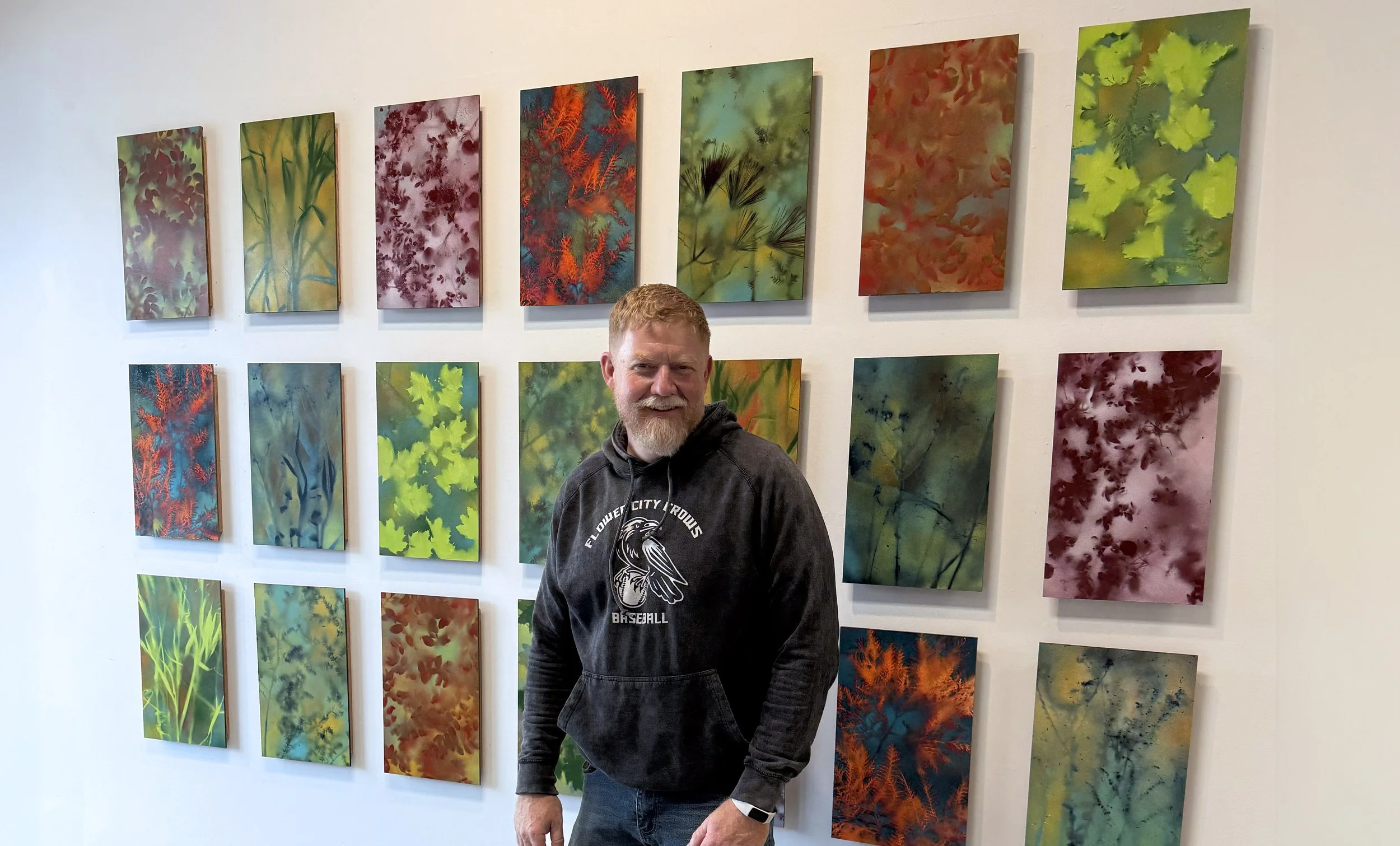
Dan DeZarn and his visiting artist wall at The Gallery, May 2026
Welcome to another blog post with our visiting artist of the month!
We’d like to introduce you to Dan of the Forest, aka Professor Dan DeZarn.
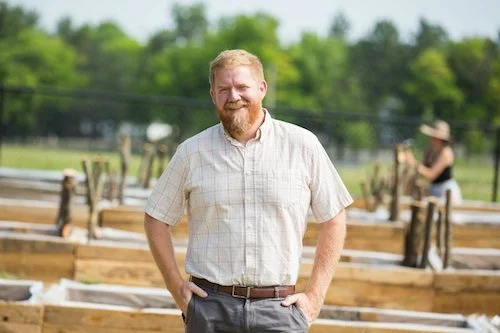
Dan DeZarn, at the eGarden at SUNY Geneseo
Dan is a professor at SUNY Geneseo where he teaches in the geography and sustainability studies program, specifically instructing intro level sustainability classes. He also teaches an applied learning class called Campus Sustainability Leadership, which allows students to participate in real hands-on initiatives, like growing food sustainably, taking care of the arboretum, removing invasive species and more.
He originally came to Geneseo to be the sculpture professor, back when Geneseo had a fine arts program. “I remember telling my wife at the time, ‘don't let me stay here longer than a couple of years’…and it's wild, now 23 years later, here I am.”
Keith and I also went to school at the college here, graduated, and ended up sticking around in Geneseo. I said to him “Oh, so you got stuck, just like us!” We were joking, of course, and wholeheartedly agreed that we aren’t stuck here, but rather we chose to stay because Geneseo is a really wonderful place to live.
“I came here to teach sculpture. I walked into a program that was pretty small, a BA program, with very modest facilities compared to where I was coming from. At the University of Tennessee, where I went to graduate school, we had a 20-ton bridge crane that you could use to lift whatever you wanted, dozens of welders, big heavy equipment — you could make anything that you could think of.” He notes that coming to Geneseo’s art program was a bit challenging without access to these tools and resources. He had to reframe his thinking and the way he made art to meet the resources available.
“At the time my artist friend Andy was referring to himself as a “post-studio artist”, with the idea that you didn't really need a studio to come up with creative projects, that you were kind of just working in the world and dealing with what you could come across.”
So Dan considers himself a post-studio artist. An artist who once worked in a studio, but now the world is his studio. That’s a beautiful concept.
Historically, Dan’s artwork and sculpture work has been ‘hard to own’. “I've made a really broad range of stuff, ranging from a big bird cage modeled after a church that I grew up going to, full of live birds that I didn't own but rented from someone, to a bridge that had a 250-pound piece of candy that I made that melted through. So really kind of time-based objects, things that were made to change over time.” To be honest, I really regret not asking him more about where it is that you can rent a bunch of live birds.
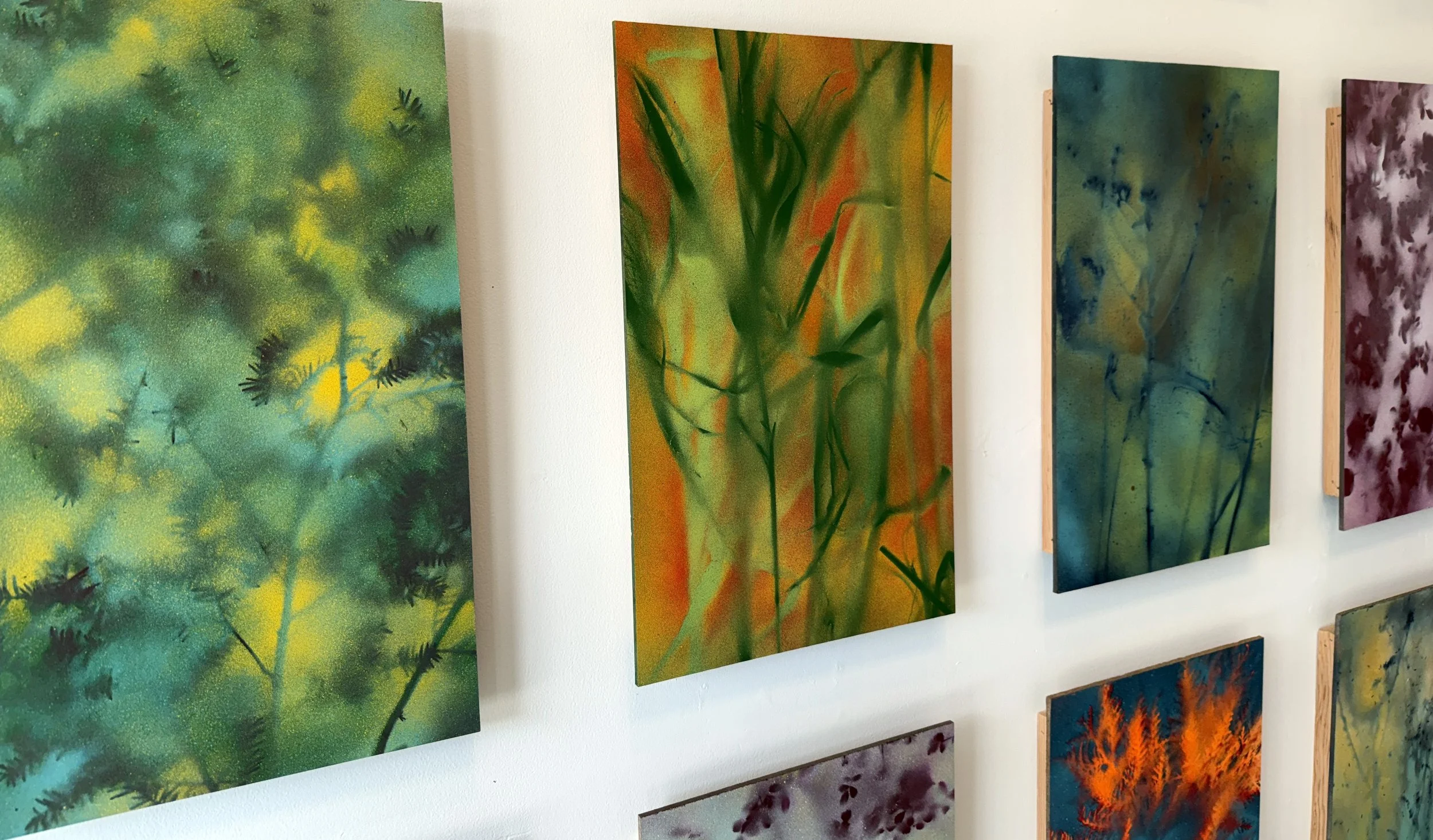
The show Dan has up at The Gallery this month features much more “own-able” work, consisting of 21 roughly 11” x 18” wood panels spray-painted using plant materials as masks. They look almost like dreamy photographs, with a grainy quality from the specks of spray paint, but feature surprising color palettes like neon orange and vibrant teal. They’re each beautiful individually but as a collection are incredibly stunning.
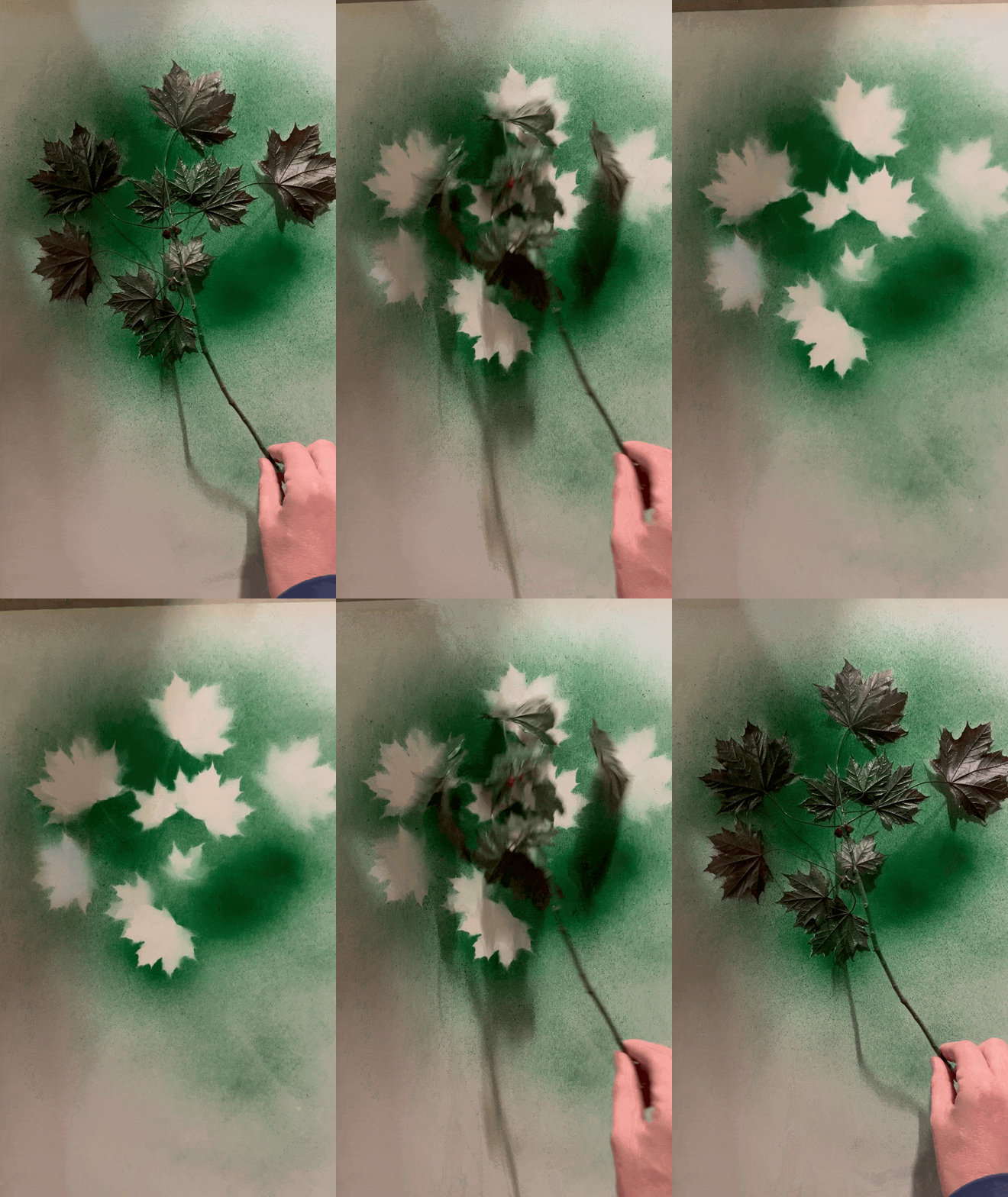
(This is just me doing my best impression of this process…plant material set down, paint sprayed over it, then plants lifted up)
A bit more about the process, in his own words: “I picked a color palette that I wanted to work with — a range of, like, 3 to 5 colors generally. And then I started with a base color and covered the entire panel with it. And then selected plant material that I wanted to work with to create kind of an environment or a space. I laid that down, and then I built up with the next color. And sometimes I shifted it so that there's a little bit of an exposure of the second color. And then I kind of dusted over top of that in different areas to create the illusion of light and space, because of the play between the colors.”
I absolutely love the way Dan arrived at this technique.
“It kind of came about because I'm painting different things, like projects I'm working on that are maybe art or maybe not. And then you see these really interesting little ghost images of the thing behind it. And I was like, oh man, I could do something with that.” So, he spotted an interesting remnant in the process of a different project, and decided to follow that into a whole collection of paintings.
One thing that I've been thinking about and talking about with my colleagues regarding AI lately (I work in marketing and I'm a designer) is that many creatives are being handed AI-generated mockups and told to just “make it like that”. But what you lose is the potential for happy accidents to happen, for something to emerge out of the process that you wouldn't have thought of before. And so I just absolutely love the idea that this whole collection emerged from an "oh, that was a weird thing that happened, let's follow that thread and see where it goes.”
Dan says, on this same subject, “Truthfully, most of the things that I have made that are worth anything come out of the process of making other stuff. And it may not even be for that thing that I'm working on — it may be the seed of the idea for the next thing.”
I asked him about how he captures these ideas as they arise, and we discovered that we have similar sketchbook habits. Which is to say that we have very poor sketchbook habits. Good intentions to fill a sketchbook back to front, but in reality, we each have many sketchbooks floating around with about the first 3 pages written on.
“I've always envied people with sketchbooks. Like, if you were a cool kid in art school in the 90s and you'd open their sketchbook, it's full of all this amazing stuff — I wanted so bad to be that kid.”
Neither of us are that kid, unfortunately. You know who is? Our gallery manager, Sarah. She is always slinging around a totebag with a large sketchbook and methodically fills it one page after another. Ah, to have such a well-organized brain!
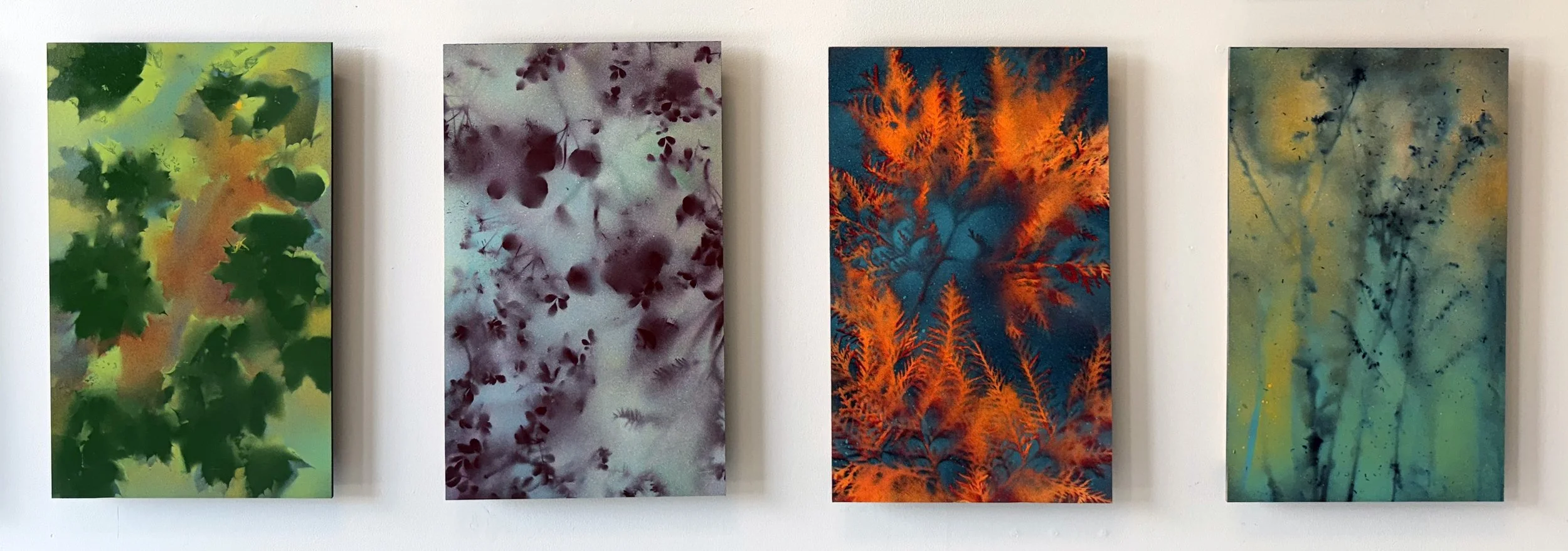
That neon orange, though, wow.
We move on to discuss the struggles in the art-making process. “When I'm making art, it is this really tumultuous thing in my head — it's like, oh, this sucks. I'll come up with an idea that I think will work and look the way that I want it to look. And it's this constant flopping back and forth between, oh that's what I want, and then, oh no, that is terrible,” Dan said. I know what he means. If you could chart the ups and downs of the process of making a piece of art, it looks like quite the roller coaster. It requires a certain amount of patience, commitment, resilience, to keep working through your self doubt and arrive at something worth showing someone else. If you’re an artist reading this, working through that self doubt - keep going, my friend. Add another layer. Or take one away. Keep going, you got this.
“One of the things I was really excited about with this body of work — I wanted it to have a late spring, summer palette. I really like the limey green leaves of maple trees right now, and I like the way the sun is really orangey in the morning about the time that I wake up with my family at the house in the woods. So I was interested in those colors. But I also saw this can of industrial fluorescent orange paint and I wanted to use that in this. For the first few days, I could not make that make any kind of sense at all and I was getting really frustrated. And the entire group without it felt really flat. And then when I finally got that orange to work, I realized — oh, this is gonna be all right.”
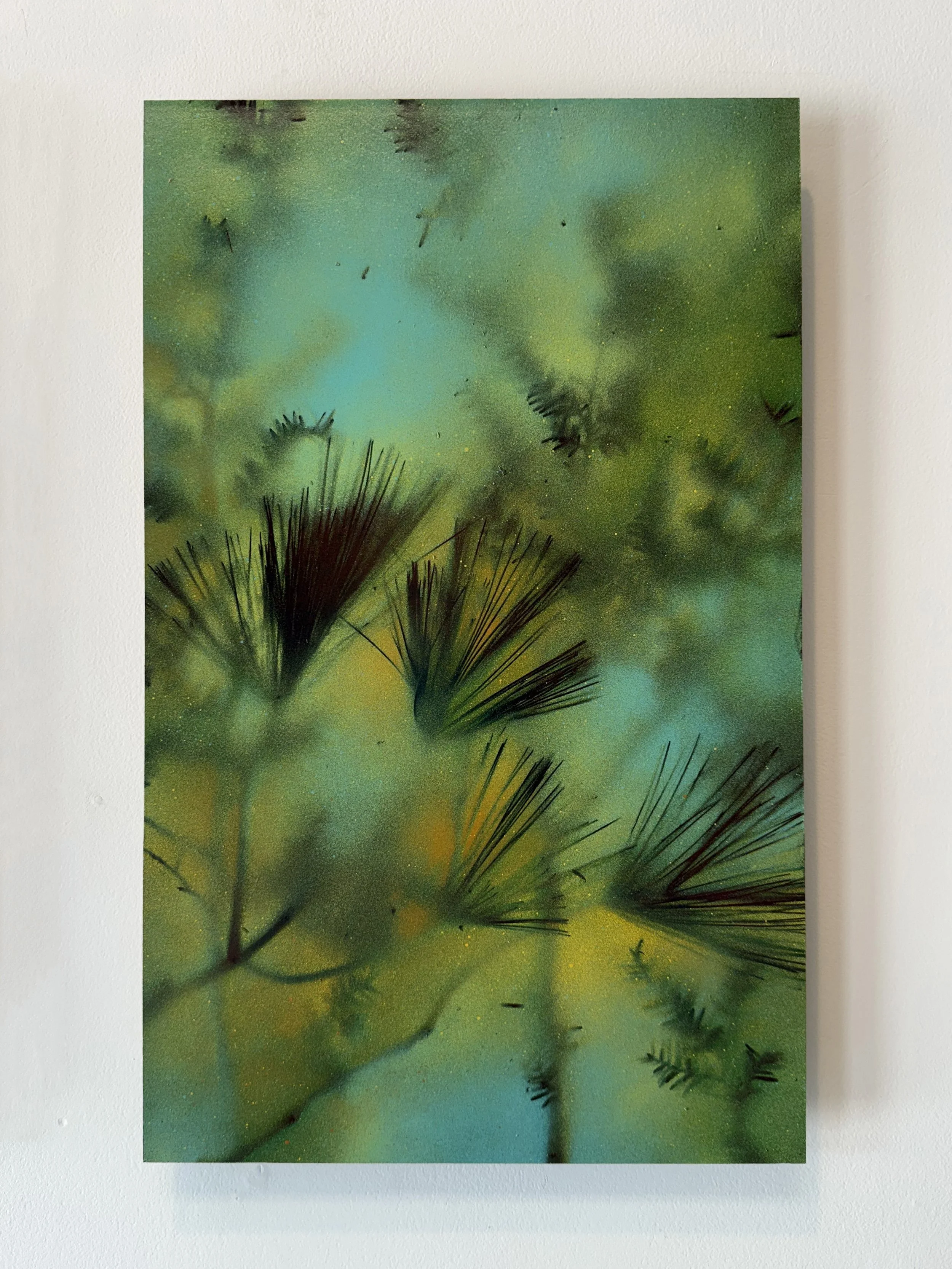
This one has a great depth of field, where some plant material was laid right on the board, and other material held away from the board.
In true post-studio artist fashion, Dan was working on these paintings in the evenings in the e-garden on campus. A student was walking through the space unexpectedly, and paused to watch him work. Dan felt a bit vulnerable in the moment, not quite ready for a viewer mid-process. He recalled that the student looked at one piece and said, "this feels really nostalgic to me, like a place I've been to before." And to that, Dan said “that was exactly the thing that I wanted to hear. I wanted it to feel like something that is familiar but that you're having a hard time placing.”
Some of that nostalgia comes from the graininess of the spray paint, the fine mist of dots of paint forming that grain, similar to film photography. And then some of that created by the distance the plant material was from the board when spraying. Plant material sitting right on the board produces sharp crisp outlines of leaves and stems, and material held even just an inch or so away creates softer outlines, forming the illusion of depth of focus.
You can spot multiflora rose, Bradford pear tree, grasses, white pine branches, hemlock branches and more among the plant material used in this collection. Spoken like a professor of sustainability, he said “The rule I gave myself was that the stuff I was using was either invasive species — which I didn't feel bad about cutting live leaves from, because we're actively removing that from spaces — or they were things I was clearing out of the garden, or things that came down in a storm.”
Dan’s painted 11×18 wood panels are available for purchase at The Gallery for $80 each. The show will be up through the end of May - we’d love for you to pop in and see them all together this month!
And there you have it, a peek into the art of Professor Dan DeZarn, aka Dan of the forest.